Pulsar Timing Arrays
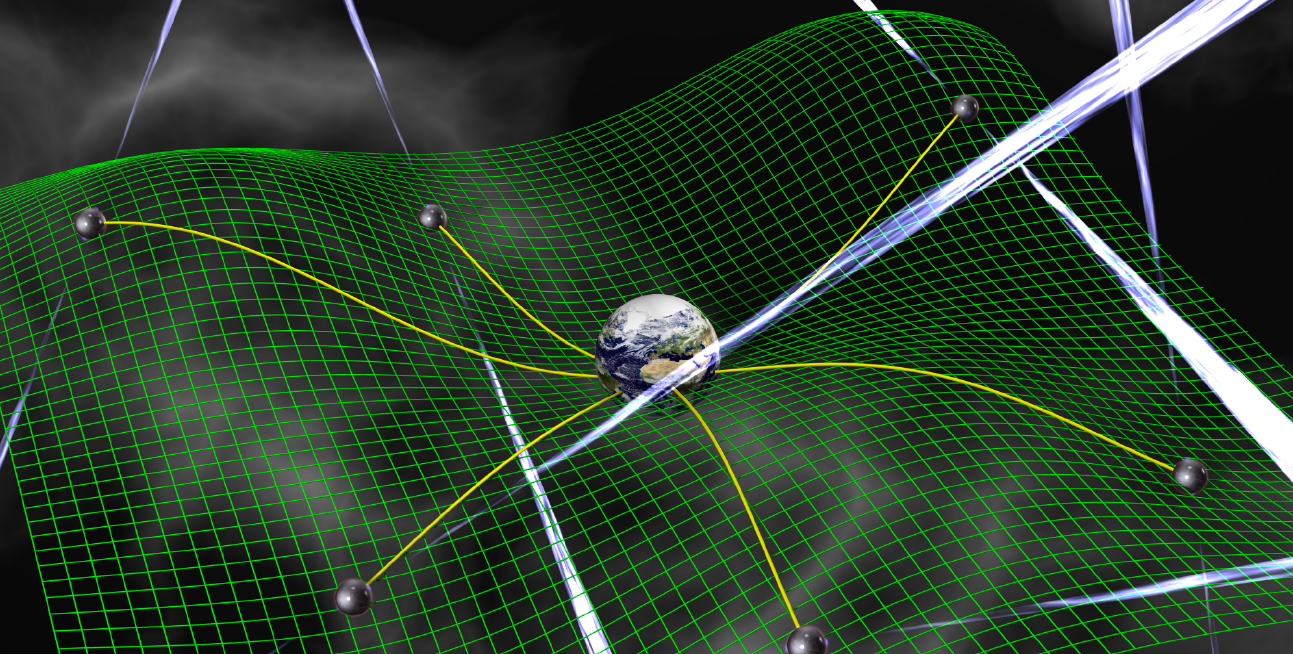
The main thrust of my research is searching for nanohertz gravitational waves from distant sources using a web of Milky Way pulsars (a Pulsar Timing Array), and unveiling the properties of the supermassive black holes, cosmic strings, or early Universe processes that produce these GWs.
Pulsars are rapidly rotating, highly magnetized neutron stars that emit beams of radiation along their magnetic field axis. Millisecond pulsars (MSPs) spin hundreds of times a second with extraordinarily stable pulse arrival times, making them natural clocks in the sky.
🎉 June 29, 2023: I announced NANOGrav’s groundbreaking evidence for a cosmic background of nanohertz-frequency gravitational waves at NSF Headquarters, alongside Kip Thorne and Jocelyn Bell-Burnell.
I have developed many of the signal models, statistical techniques, and coding infrastructure underlying the global pulsar timing array effort.
Recent Honors & Awards
| Year | Award |
|---|---|
| 2025 | Bruno Rossi Prize (with NANOGrav Collaboration), American Astronomical Society |
| 2025 | Chancellor’s Award for Research, Vanderbilt University |
| 2024 | Appointed to ESA-NASA LISA Science Team (1 of 6 US scientists) |
| 2024 | Frontiers of Science Award in Theoretical Physics |
| 2024 | Eddington Lecturer, University of Cambridge & Royal Astronomical Society |
| 2024 | Fred Kavli Plenary Lectureship, American Astronomical Society |
| 2021 | NSF CAREER Award |
Leadership & Affiliations
- Director, Vanderbilt Initiative for Probes of Extreme Relativity (VIPER)
- Chair, NANOGrav Collaboration (2023–present)
- Representative, Gravitational Wave International Committee (GWIC)
- Member, ESA-NASA LISA Science Team (1 of 6 US scientists)
- Co-Lead, NANOGrav’s GW Evidence Paper (2023)
- Fellow, Royal Astronomical Society
- Lifetime Member, American Physical Society
Research Funding
Total as PI/Co-PI/Institutional-PI: $6 million
Selected active grants:
- NASA LISA Preparatory Science (2026–2028): Population inference within the LISA global fit
- NSF Windows on the Universe (2023–2026): Mapping host galaxies of low-frequency GW sources
- NSF CAREER (2021–2026): Unveiling the Nanohertz GW Discovery Landscape
Book
📘 “Nanohertz Gravitational Wave Astronomy”
CRC Press, November 2021 (172 pp)
ISBN: 9780367768621